
The Maddalena Bridge in Borgo a Mozzano: History and Legend of the Devil's Bridge
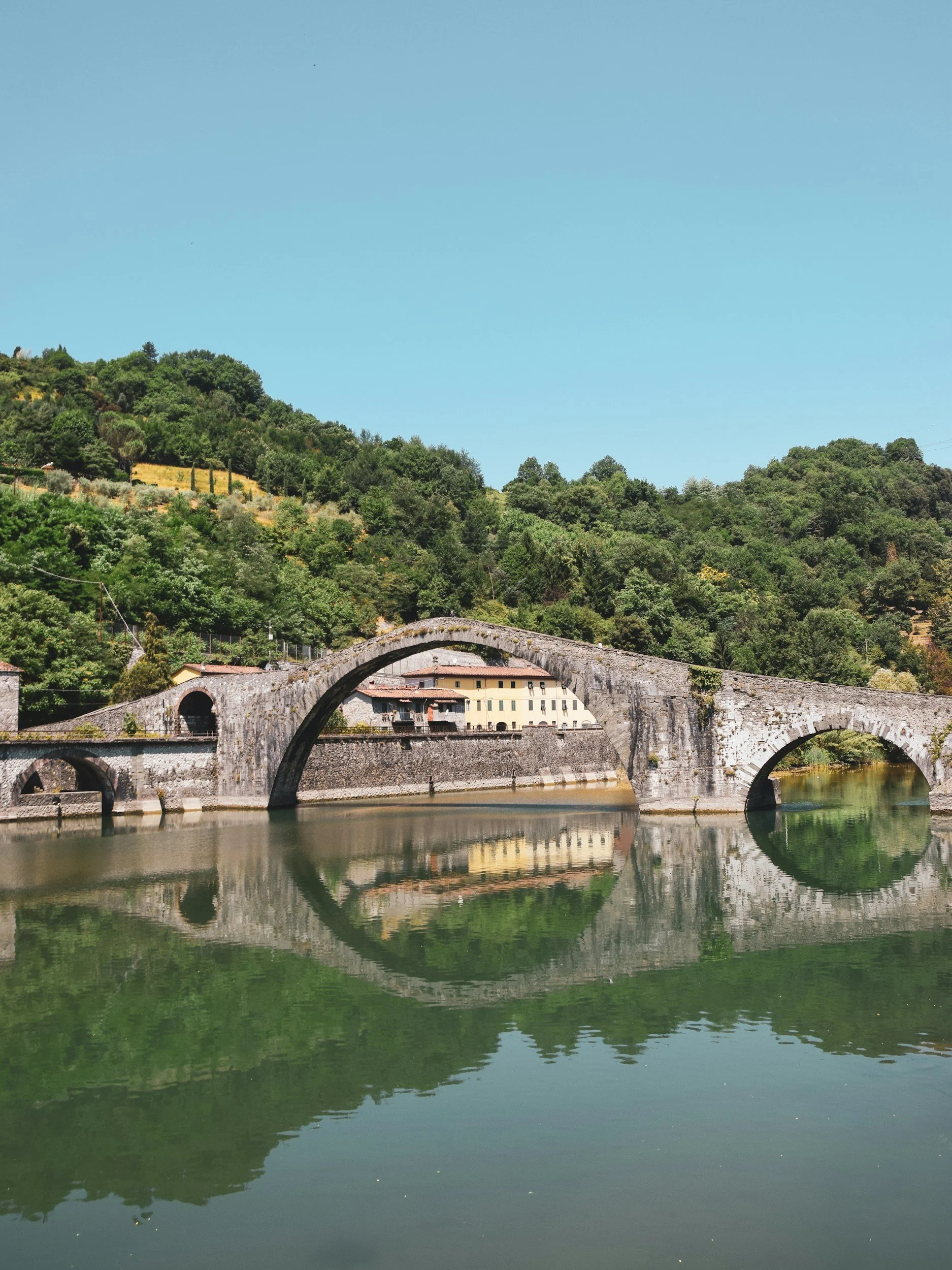
You see it from a distance, and the first reaction is always the same: it should not be standing. The Maddalena Bridge crosses the river Serchio at Borgo a Mozzano with a central arch so tall and so out of proportion — nearly eighteen metres high, with a span of almost thirty-eight — that it dwarfs the three smaller, entirely asymmetrical arches beside it. Ninety metres of stone that look like a personal argument with gravity.
In the Middle Ages, faced with something like this, the people of the valley drew the only reasonable conclusion: no man could have built that bridge. Hence the name everyone knows it by — the Devil's Bridge.
The Legend of the Pact
The best-known version tells of a desperate master builder. The work was behind schedule, the floods of the Serchio kept destroying what had been built, and the deadline was closing in. One evening, sitting alone on the riverbank, he cursed so violently that he summoned the devil himself.
The bargain was simple: the bridge finished in a single night, in exchange for the soul of the first living creature to cross it. The builder agreed. By dawn, the bridge was there.
Then came the remorse. The man ran to the village priest, who heard his confession and found the loophole: the following morning, before any human being could set foot on it, a dog was sent across (in other versions, a pig chasing an apple). The devil, cheated, threw himself into the Serchio and was never seen again.
In some versions the protagonist is Saint Julian the Hospitaller, patron of travellers. In others, the bridge is where Lucida Mansi, a noblewoman from Lucca terrified of growing old, sold her soul for thirty more years of youth. Similar stories attach to bridges across half of Europe — there are Devil's Bridges in Spain, France, Switzerland and Portugal — but the one at Borgo a Mozzano remains the most famous of them all.
The Real History (Which Is No Less Interesting)
The bridge was most likely commissioned by Matilda of Canossa around the turn of the twelfth century, so that travellers and pilgrims could cross the Serchio, reach Lucca and join the Via Francigena on their way to Rome. The Serchio Valley and the Garfagnana were then a strategic corridor between Tuscany and the north.
In the early fourteenth century Castruccio Castracani, lord of Lucca, had it rebuilt. It was probably during that work that the smaller arches — perhaps originally timber — were rebuilt in stone. Which is, rather prosaically, the explanation for the asymmetry that went on to generate centuries of legend. The piers, after all, rest on the only points where the riverbed offered solid enough rock.
The official name arrived in the sixteenth century, from a hermitage dedicated to Saint Mary Magdalene built in 1526 at the foot of the bridge, on the left bank. The statue of the Magdalene it once housed, attributed to the Della Robbia workshop, is now in the church of San Jacopo in the village.
The rest is recent history: a devastating flood in 1836 and, at the end of the nineteenth century, the cutting of an extra arch on the Borgo a Mozzano side to let the Lucca–Aulla railway through, which permanently altered the original profile. During the Second World War the retreating German army mined the bridge — but never blew it up.
How to Visit
The Maddalena Bridge is crossed on foot, can be seen at any hour and costs nothing. Twenty minutes is enough — and yet it is one of those places where you end up staying far longer than you meant to.
A few practical notes:
The best light is early morning or evening, when the Serchio is still and the bridge is reflected in the water.
The classic photograph is not taken from the bridge but from the bank: walk down towards the river and shoot from below.
The central arch is steep, and the steps are stone: wear decent shoes.
On foggy autumn days the place is at its best. It is no accident that the legend was born here.
Borgo a Mozzano: Beyond the Bridge
The Gothic Line. In the hills above the village lies the best-preserved stretch of the entire German defensive line of 1944: bunkers, tunnels, gun positions, and a long reinforced-concrete anti-tank wall still clearly visible at the entrance to the village. There is a dedicated museum park, and guided visits are organised.
Halloween. Since 1993, on the night of 31 October, Borgo a Mozzano has hosted what is generally considered Italy's largest free Halloween festival: tens of thousands of visitors, performances throughout the village, and a re-enactment of the Lucida Mansi legend whose procession of demons ends on the bridge itself, under fireworks. With a legend like that behind you, it was almost inevitable.
The old village. Arcades, narrow lanes, the church of San Jacopo with its Della Robbia Magdalene — and, in April, the historic azalea market, held here since 1970.
Beyond the Bridge: The Serchio Valley
The Maddalena Bridge is the gateway to one of the loveliest and least-crowded valleys in Tuscany. Head upstream and you reach Bagni di Lucca, an elegant, faintly melancholy spa town much loved by the nineteenth-century English; further on lies Barga, one of the most beautiful villages in Italy; and beyond that the true Garfagnana, with the Grotta del Vento cave and the Apuan Alps on the horizon. Lucca, with its walls, is twenty minutes away.
Getting There from Villa Agnolaccio
About an hour by car: take the A11 motorway from the villa to Lucca, then the SS12 up the Serchio valley. The bridge is right on the road, at the entrance to Borgo a Mozzano, with parking nearby.
Villa Agnolaccio: The Ideal Base for Exploring the Serchio Valley
From Villa Agnolaccio the Serchio Valley is an hour away — but, more to the point, it is an hour away without your having to stay there. You go, you look, you eat well, and in the evening you come back to somewhere entirely different: hills, olive groves, a garden, and a quiet you will not find down in the valley.
That is the advantage of a base in this position. Within an hour's drive lie Lucca, the Garfagnana, the Versilia coast, the thermal spas of the Valdinievole and Florence. A different direction every day, and never a suitcase to repack.
For the bridge itself, the advice is to go early in the morning or late in the afternoon: fewer people, better light — and time enough for a walk around Lucca on the way home.
→ Book your stay at Villa Agnolaccio and set off to discover the Serchio Valley.