
Rocchetta Mattei: The Moorish Castle Hidden in the Apennines
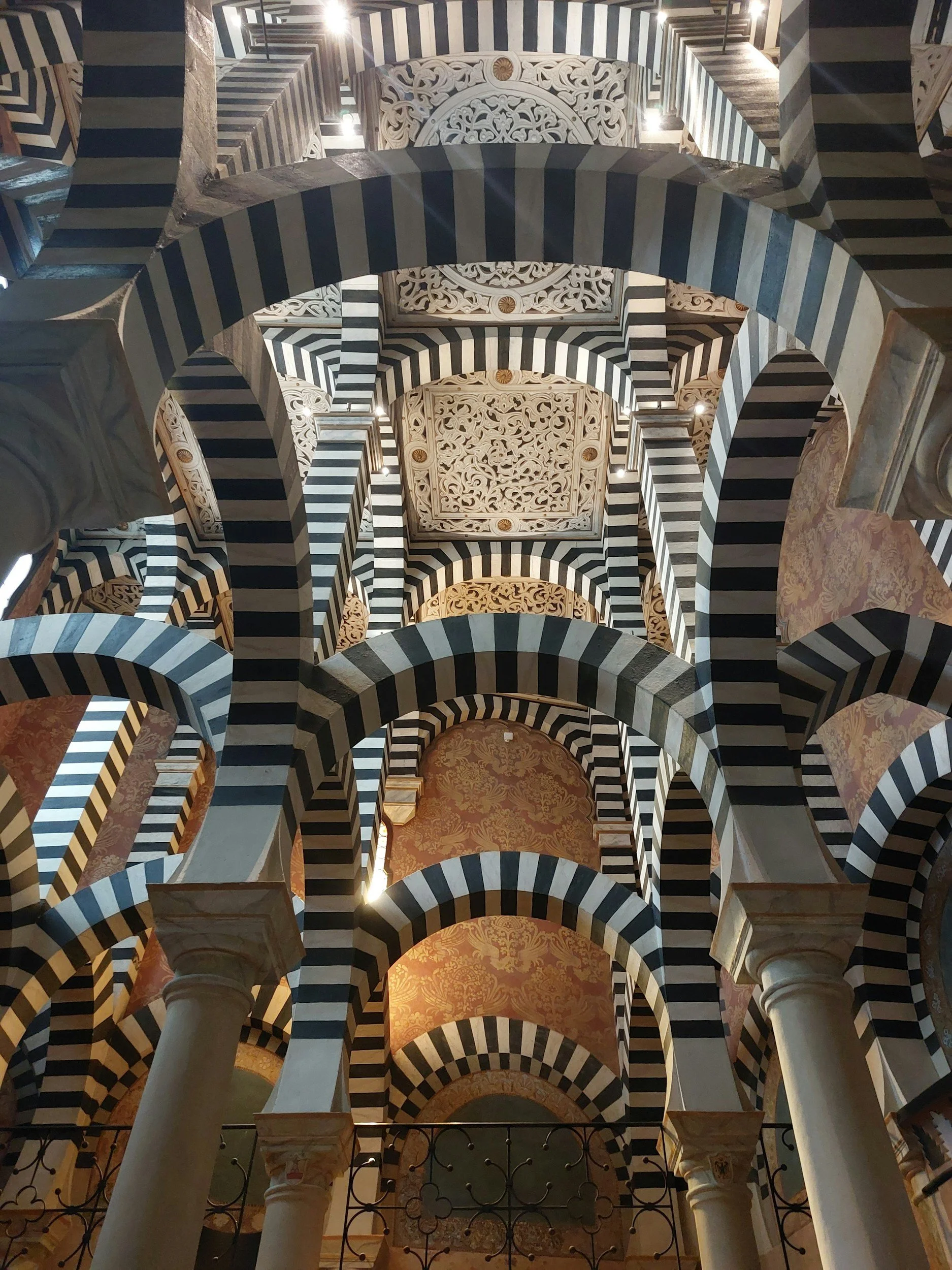
Some buildings feel less like the result of a plan than of a dream. The Rocchetta Mattei — clinging to a rocky spur above Riola, in the Bolognese Apennines — is one of them: a nineteenth-century castle where Andalusian courtyards, black-and-white striped chapels, neo-Gothic towers and Art Nouveau staircases coexist without anyone, apparently, ever having thought this might be a problem.
It is not a medieval castle, though it looks like one. It is not an aristocratic residence like any other, though it has the luxury of one. It is the self-portrait, in stone, of a single man: Count Cesare Mattei, who built it as the world headquarters of the medicine he had invented.
Who Was Cesare Mattei?
Cesare Mattei (1809–1896) was made a count by Pope Pius IX in 1847 and was among the founders of the Cassa di Risparmio di Bologna. After his mother died of cancer, he became convinced that the medicine of his day was powerless, and began to study on his own.
The result was electrohomeopathy: a system of herbal remedies, granules and so-called "electric fluids" that Mattei developed and produced here, inside the castle. Its success was extraordinary and global. By the time of his death there were more than two hundred production centres for the Mattei remedies around the world — and the count was famous enough to be mentioned by Dostoevsky in The Brothers Karamazov.
In 1850 he bought the ruins of the medieval Rocca di Savignano and started building. He never really stopped: the Rocchetta remained a building site for the rest of his life, supervised personally by him, room after room, tower after tower.
Inside the Castle: What You Will See
The visit is a walk through styles that have no business working together — and yet do.
The Court of the Lions, a scaled-down reproduction of its namesake in the Alhambra of Granada, with majolica tiles brought from Seville.
The Chapel, inspired by the Mezquita of Córdoba, with its forest of black-and-white arches: the most photographed room in the castle, and the resting place of the count himself.
The Hall of the Ninety, so called because Mattei dreamed of celebrating his ninetieth birthday here with eighty-nine other ninety-year-olds. He died at eighty-seven.
The spiral staircase of honour, the corridors, the terraces looking out over the mountains.
The detail that stays with you, though, is the one the guide reveals as you go: almost nothing here is what it seems. The "mosaics" are painted. The arches that look like marble are wood and plaster. The inlaid ceilings are painted canvas, and some are papier-mâché. The Rocchetta is a stage set — built with an ambition that borders on vertigo.
Ruin and Rebirth
After the count's death the Rocchetta passed to his adopted son, Mario Venturoli Mattei, and then, in 1959, to a local merchant who ran it as a tourist attraction, adding dungeons and pits that had never existed. In the 1980s the castle was closed and left to fall apart.
It was rescued by the Fondazione Cassa di Risparmio in Bologna, which bought it in 2005 and began the restoration. It reopened to the public in 2015. Today the foundation owns it and the municipality of Grizzana Morandi runs it: part of the complex is still under restoration, and a share of every ticket goes towards the work.
Visiting: What You Need to Know
Entry is by guided tour only, in small groups, and booking is always compulsory: tickets are bought online on the official website, choosing your day and time slot.
Openings are concentrated on weekends and public holidays, with limited places. In high season, book well in advance — slots sell out quickly.
The full ticket costs €12, with reductions for children and for anyone arriving by train who shows a valid ticket.
The visit lasts about an hour. Arrive fifteen minutes early.
The castle has lifts. Pets and pushchairs are not allowed.
(Opening times and prices can change — it is always worth checking the official website before setting off.)
What Else Is Nearby
The Rocchetta makes a good half-day trip, but the valley around it deserves the rest of your time. In Riola stands the church of Santa Maria Assunta, the only religious building Alvar Aalto ever designed in Italy: after the Moorish exuberance of the castle, the contrast is unforgettable. In Grizzana Morandi you can visit the house-museum of Giorgio Morandi, and not far away are the stone village of La Scola and the sanctuary of Montovolo, with its enormous view down the valley.
Getting There from Villa Agnolaccio
The Rocchetta Mattei is just over an hour by car from Villa Agnolaccio, along the SS64 Porrettana: you climb from Pistoia to the pass, drop down into Porretta Terme, and follow the Reno valley to Riola. It is a mountain road, all curves and views — allow a little more time than your satnav suggests, and you will not regret it.
There is also the railway, which may well be the finest way to arrive. The historic Porrettana line has connected Pistoia to Bologna since 1864 and stops at Riola: from the station it is a little over a kilometre uphill to the castle, about fifteen minutes on foot. Arriving by train also earns you a reduced entry ticket.
Villa Agnolaccio: The Ideal Base for a Day in the Apennines
Villa Agnolaccio sits in the hills above Pistoia, on exactly the right side of the Apennines for a day like this one: close enough to make the trip effortless, far enough removed to give you back, in the evening, a completely different atmosphere — olive trees, the garden, silence.
The best rhythm is a slow one: leave after breakfast, take the guided tour late morning or early afternoon, have lunch in a mountain trattoria on the Emilian side, and drive back as the light softens over the hills.
It is the kind of day that works best when there is no hurry to get home. And a period villa with a large garden, at the end of a hillside road, is precisely the sort of place where nothing feels urgent.
→ Book your stay at Villa Agnolaccio and plan your visit to Rocchetta Mattei.