
The Nottolini Aqueduct: The Most Unusual Thing to Do in Lucca
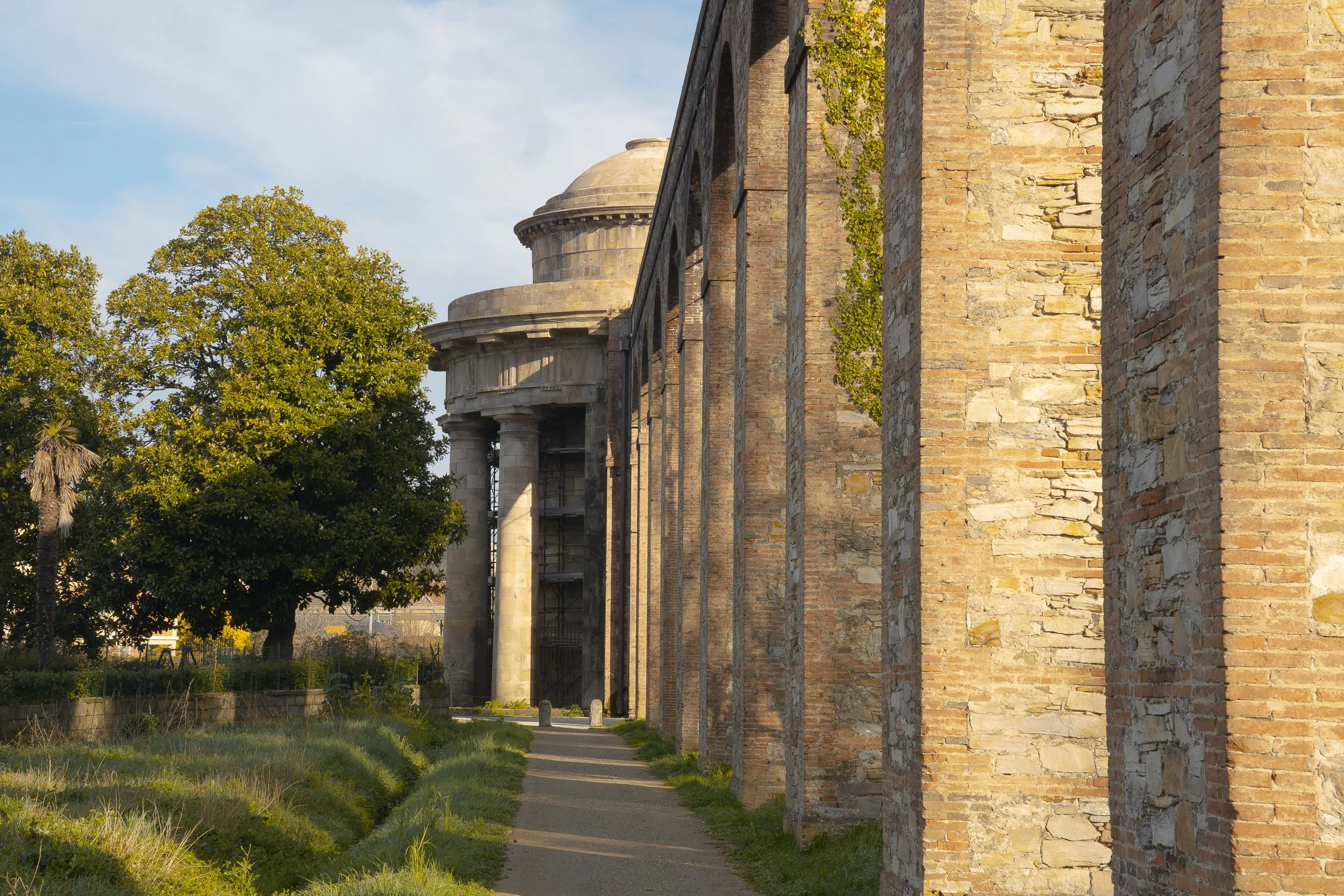
Photo by Stefano Gabryel, naturalist photographer and hiking guide in Tuscany. Guests of Villa Agnolaccio enjoy an exclusive 10% discount on his guided excursions.
Everyone knows Lucca's Renaissance walls, the Piazza dell'Anfiteatro, the Guinigi Tower with its rooftop oak trees. But few people know that just a few kilometres from the city centre, stretching across the Lucchese countryside like a forgotten Roman monument, stands one of the most evocative and least-visited landmarks in all of Tuscany: the Nottolini Aqueduct.
Four hundred and sixty brick arches crossing plains and hills for more than three kilometres. A path running at their feet through woodland, streams and pure natural springs. And a legend — the Golden Words — that gives this place an almost magical quality. If you are looking for something genuinely different to do in Lucca, you have found it.
Who Was Lorenzo Nottolini and Why Did He Build the Aqueduct?
Until the early 19th century, the city of Lucca relied on underground wells for its water supply — wells that were often of poor quality. In 1822, Maria Luisa di Borbone, Duchess of Lucca, commissioned the royal architect Lorenzo Nottolini to solve the problem once and for all: to build an aqueduct that would bring clean, pure water directly from the springs of the Pisan Mountains into the city.
Nottolini worked on the project for nearly thirty years — from 1823 to 1851 — creating something that went far beyond a hydraulic infrastructure. The aqueduct that bears his name is a masterpiece of neoclassical engineering: 460 brick arches standing approximately 12 metres high, supporting a double water channel at their summit, two neoclassical tempietti at either end of the route, and an intricate system of springs, underground galleries and filtration of extraordinary precision.
Today the aqueduct no longer carries water to Lucca — the city's fountains are fed by a modern underground network — but it remains architecturally intact, interrupted only by six arches demolished in the 20th century to allow the passage of the A11 motorway.
What to See Along the Nottolini Aqueduct
The Tempietto di San Concordio
The ideal starting point for those arriving from Lucca. This elegant circular building in Doric neoclassical style, constructed between 1823 and 1825, was the aqueduct's final cistern: here the water collected in a large double marble basin before being pushed under pressure through underground metal pipes to the fountains of the city centre. From the Tempietto di San Concordio, a path follows the arches out into the countryside.
The Arches Across the Countryside
Walking beneath the arches of the aqueduct is an experience unlike anything else in ordinary Tuscany. The structure advances in a dead-straight line across the plain with the implacable logic of a Roman aqueduct — which is no coincidence, as Nottolini drew direct inspiration from ancient engineering. In places the surrounding landscape is so silent and unspoilt that it seems completely outside of time.
The Golden Words — Le Parole d'Oro
Approximately three kilometres from the Tempietto di San Concordio lies the most evocative spot along the entire route: the Parole d'Oro — the Golden Words. The name has an almost legendary origin: 19th-century peasants, seeing the brass letters of a commemorative inscription gleaming on a small bridge, mistook them for real gold. From that misunderstanding the name was born — and today the place retains an almost fairy-tale quality, with the woodland closing in around the stream and the reflections of water on stone.
The Tempietto di Guamo
At the far end of the arcaded section stands the Tempietto di Guamo, the collection reservoir where water gathered from the streams of the Pisan Mountains was channelled and filtered before being fed into the double canal above the arches. This is where the aqueduct "begins", and the surrounding area — with the Rio San Quirico flowing through the woodland — is among the most beautiful along the entire route.
The Astronomical Observatory on Monte della Gallonzora
For those who extend the excursion beyond the Tempietto di Guamo, climbing through the village of Vorno leads to the Astronomical Observatory on Monte della Gallonzora. The absence of light pollution makes it one of the best spots in the area for stargazing. By day, the panorama over the Lucchese hills — and, on clear days, the Apuan Alps — makes the climb worthwhile on its own.
How to Visit: On Foot or by Bicycle
The main route along the arches is flat, unpaved and easily managed on foot or by bicycle. It is accessible to everyone, including children and those not used to hiking. The main stretch — from the Tempietto di San Concordio to the Tempietto di Guamo — is approximately 3 kilometres, walkable in under an hour in either direction.
For a fuller excursion, continue beyond Guamo along the path that climbs through the woodland to the Parole d'Oro and the Observatory. This version is of moderate difficulty and takes around 3 to 4 hours in total. Hiking boots are recommended for the uphill section.
The aqueduct also forms part of the Via degli Acquedotti, the long-distance hiking route connecting Lucca to Pisa through the Pisan Mountains, partly following the routes of the Nottolini Aqueduct and the Medici Aqueduct of Pisa.
How to Get to the Nottolini Aqueduct
The most convenient starting point is the Tempietto di San Concordio, in the neighbourhood of the same name just outside Lucca's walls. Alternatively, you can park near the sports ground at Sorbano del Giudice (GPS coordinates: 43.824736, 10.514871) and reach the arches on foot in a few minutes. From central Lucca it is approximately 9 km by car, taking around 12 minutes along the SS12.
The Parole d'Oro Nature Park
The area around the springs and the Parole d'Oro is now a managed nature park, run by the Associazione Il Tuffetto, which organises guided visits and educational activities. The meadow around the little bridge is wide, well-kept and perfect for an open-air picnic away from the city.
Villa Agnolaccio: The Perfect Base for Discovering Lucca — and Its Secrets
Lucca is approximately 50 km from Villa Agnolaccio — less than an hour by car through the Tuscan countryside. Our B&B, nestled among cypress trees and olive groves just a few kilometres from Pistoia, is the ideal base for those who want to explore Lucca properly: not just the walls and Piazza dell'Anfiteatro, but also the lesser-known places like the Nottolini Aqueduct, which require a little more time and the freedom of your own transport to discover.
Staying at Villa Agnolaccio means being able to move freely between Pistoia, Lucca, Montecatini and Florence — without the rush of day-trip tourism, and with a historic villa to come back to each evening.
Would you like to plan your Tuscan stay? Get in touch.