
A San Gimignano Day Trip: the Fourteen Towers, the Art and How to Miss the Crowds
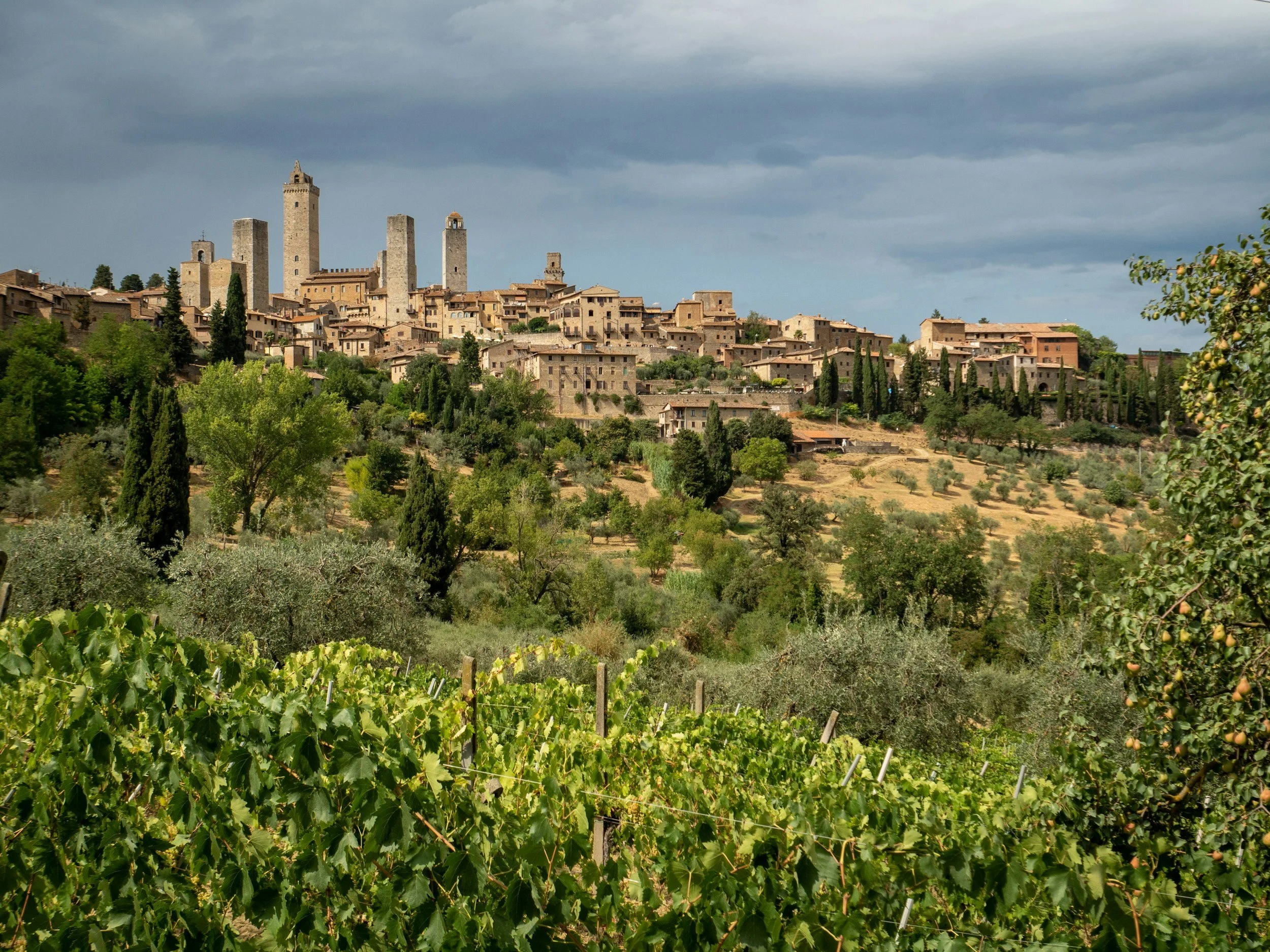
At its height San Gimignano had seventy-two towers. Twenty-five were still standing in 1580, and fourteen survive today. They're enough to give this Val d'Elsa town a skyline you can pick out from miles away. The old centre has been a UNESCO World Heritage Site since 1990. That brings a stream of visitors who fill Via San Giovanni from morning to evening in high season. It's about an hour and twenty minutes by car from Villa Agnolaccio, so it pays to settle three things first: what time to arrive, where to leave the car, and what to book.
Fourteen towers out of seventy-two
The towers record a contest between families. Anyone with the means built higher than the neighbours, and in a town perched at 324 metres that competition could be read from a distance. The oldest is the Torre Rognosa, from the early 13th century. The count of survivors shifts with the criteria: some texts reach sixteen by including the Collegiata's bell tower and the Casa-Torre Pesciolini. Other towers were cut down and can still be spotted, truncated, inside the houses of the old centre.
The wealth that paid for all this came off the road. The Via Francigena crossed town along the axis between Porta San Giovanni and Porta San Matteo. Archbishop Sigeric of Canterbury, travelling between 990 and 994, noted the stage down as Sancte Gemiane. Three centuries later, on 8 May 1300, Dante Alighieri arrived as an ambassador of the Guelph League. The hall of the Palazzo Comunale where he spoke carries his name and holds Lippo Memmi's Maestà.
The Duomo, Santa Fina and Benozzo Gozzoli's working years
The Collegiata di Santa Maria Assunta, finished in 1148, has a plain façade that tells you nothing about the inside. The walls are covered in frescoes: Bartolo di Fredi's Old Testament stories, Taddeo di Bartolo's Last Judgement, and the Santa Fina chapel painted by Domenico Ghirlandaio.
There's also a St Sebastian by Benozzo Gozzoli with a precise date behind it. He painted it between 1 April and 28 July 1464, while plague was running through Tuscany and work on his frescoes at Sant'Agostino had stopped. That work resumed afterwards and was finished in 1465. In the church of Sant'Agostino, at the far end of town, the choir tells the saint's life in seventeen scenes. Gozzoli painted them with his assistants, Pier Francesco Fiorentino and Giusto di Andrea. They were commissioned by the friar Domenico Strambi, known as the Paris doctor because he had studied there.
Sant'Agostino sits well away from the main street, and it's usually the quietest part of the visit.
Climbing the Torre Grossa
From the Palazzo Comunale you can climb the Torre Grossa, 54 metres high and completed in 1311. The view from the top takes in the Val d'Elsa and, on clear days, a good deal more. The climb is included in the combined ticket along with the Pinacoteca, which holds works by Pinturicchio, Benozzo Gozzoli and Filippino Lippi.
Vernaccia and the Rocca di Montestaffoli
The name Vernaccia turns up in a town register as early as 1276, when San Gimignano taxed the wine coming in and going out. On 3 March 1966 Vernaccia di San Gimignano became the first DOC in the history of Italian wine. In 1993 it was raised to DOCG, the only white one in Tuscany.
You can taste it in cellars around the town and inside the walls. Above the rooftops, the Rocca di Montestaffoli, built in 1351 after the town submitted to Florence, now houses the Vernaccia Wine Experience. From its walkway you look down on the towers, and sunset up there is one good reason to stay late.
When to go, and when not to
Coach groups tend to arrive mid-morning and leave in the afternoon. Walk in before ten or after five and you get the same squares with far fewer people in them, in better light for photographs.
Since 1 May 2026 the old centre has had a limited-traffic zone with camera-controlled gates, so set your navigation to a car park rather than to the squares. If you're coming in autumn or winter, check the opening days first. The Duomo's own site lists two closure periods for the Collegiata, 15 to 31 January and 15 to 30 November. Museum hours get shorter from 1 November.
Practical information
Distance from Villa Agnolaccio: about 88 km, an hour and twenty minutes by car.
Parking (2026 rates): P1 Giubileo costs €2 for the first and second hour, €1.50 for each hour after that, up to €7 a day. P2 Montemaggio, P3 Bagnaia Superiore and P4 Bagnaia Inferiore start at €2.50 to €3 an hour and run up to €15 for the first day. P5 Santa Lucia, about 3 km out, is for campervans. You pay at the machines, in cash or by card.
CityBus: the SG1 line links Le Mosse, the centre and Santa Lucia all year, but from June to September it doesn't run inside the walls; the useful stops are Porta San Giovanni and Porta San Matteo. Timetables are on at-bus.it.
San Gimignano Pass: €15 full, €12 for ages 6 to 17, valid 3 days, plus a €1 booking fee. It covers the Collegiata complex, the Palazzo Comunale with the Pinacoteca and Torre Grossa, the Santa Chiara complex and the church of San Lorenzo in Ponte.
Hours: the civic museums open 10:00-19:30 from 1 April to 31 October and 11:00-17:30 from 1 November to 31 March. In summer the Collegiata opens 10:00-19:30 Monday to Friday, 10:00-16:30 on Saturday and 12:30-19:30 on Sunday, with shorter winter hours. Times can change for services, so check the museums' site before you set off.
Combine it with: San Miniato is on the way back towards Pistoia, and the Padule di Fucecchio is a little further along.
Villa Agnolaccio: a base for days out in the Val d'Elsa
Villa Agnolaccio sits on the hills 3 km from the centre of Pistoia, about an hour and twenty minutes from San Gimignano. Leave early and you'll reach the town as the museums open and be back for dinner with daylight still on the road. Florence and Lucca are about an hour from here. Our early-18th-century villa, with its garden and olive grove, works well as a base for visiting several towns on separate days.