
The Balze of Volterra: the Cliffs That Are Eating an Etruscan City
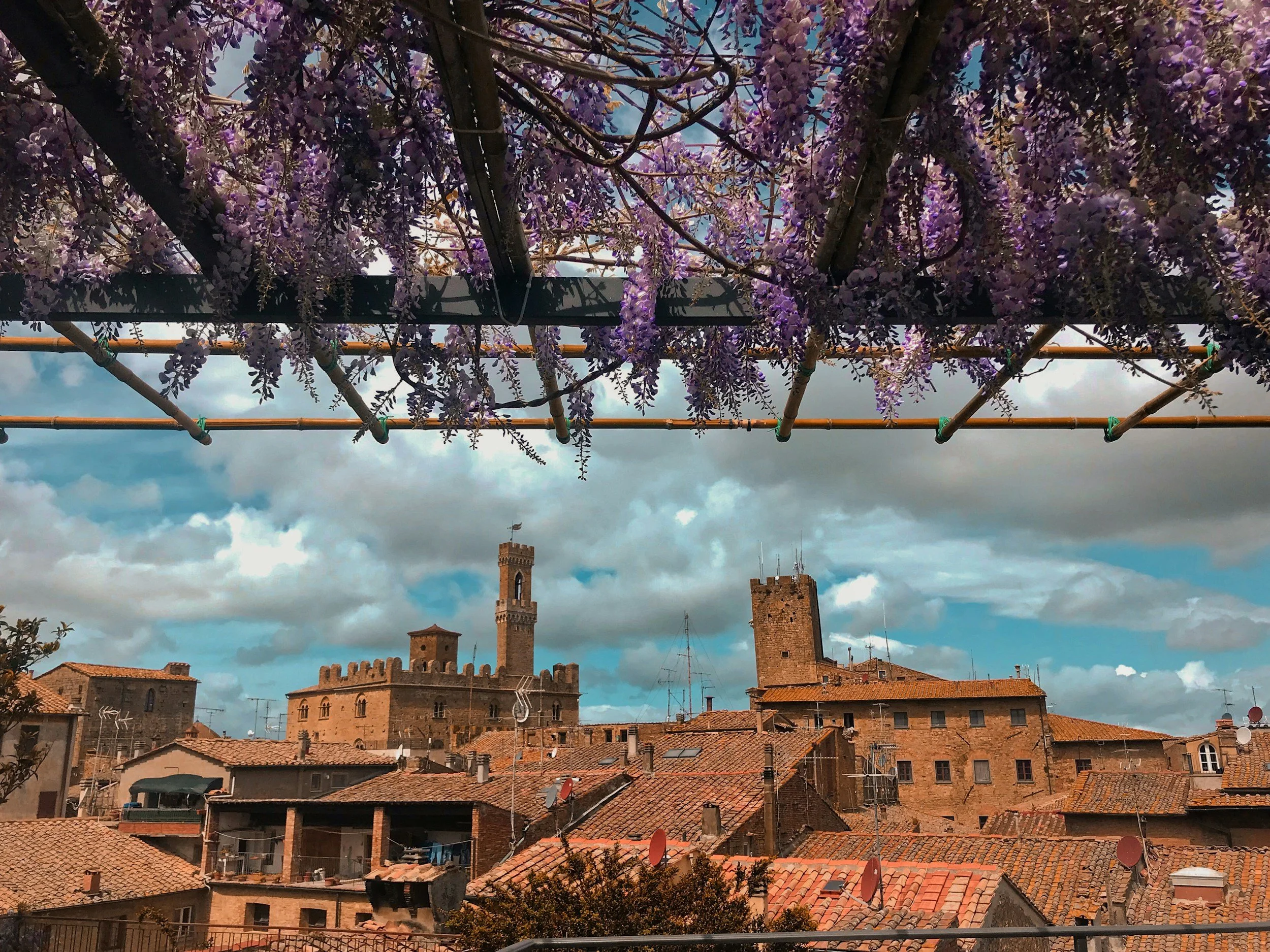
At Volterra the landscape carries the town away, piece by piece. On the flank of the hill, between the Cecina and Era valleys, the Balze open up. They're vertical walls of sand and clay tens of metres high, with badlands running down towards the fields below. Volterra's largest Etruscan necropolis went over those edges, along with churches, monasteries and roads. The erosion is still going, slowly. From Villa Agnolaccio this is the longest of the day trips, an hour and forty minutes by car, and it deserves a full day.
What the Balze are
The explanation lies in two layers of ground, one on top of the other. Above are the permeable sands of the Villamagna Formation; below, the clays of the Blue Clay Formation. Rainwater runs quickly through the sand, reaches the clay and wears it away. When the support gives, the block above collapses all at once and leaves a vertical wall. That's the shape the place is named for.
The area protected as a geosite covers 88.86 hectares. Attempts to stop the process began under the grand dukes and continued through the 19th century, with masonry works that achieved nothing. Replanting the slopes has slowed the erosion, without halting it.
What the Balze have swallowed
The list of losses is long. Volterra's largest Etruscan necropolis has almost entirely gone. A few tombs survive on the ground near the Badia and on the Guerruccia plain. The urns on show today in the Guarnacci museum largely came from there. At the start of the 19th century a sudden landslide took a long stretch of the Etruscan walls and many houses with it.
One church had to be replaced by another. The old San Giusto in Botro stood over the tombs of Saints Justin and Clement. Tradition traces its origins to two chapels of the 6th century, later rebuilt and renovated around the year 1000 inside a Benedictine monastery. When the ground gave way, the parish had to start again. The new church of San Giusto was begun on 28 October 1628, to designs by Giovanni Coccapani. His pupil Ludovico Incontri built it, and it was consecrated in 1775.
Beside it stands the Camaldolese abbey of Saints Justin and Clement, a complex whose origins go back to the 11th century. The Camaldolese held it from 1113 to 1808 and the Benedictines returned from 1816 to 1846. The monks left in the mid-19th century, after an earthquake and with the Balze closing in. The cloister and the refectory have survived well. The abbey can be visited again today, free and on seasonal hours, but the information changes often: ask the Volterra tourist consortium on 0588 86099.
Getting there, and where not to stand
From the centre you leave by Porta San Francesco, the largest of Volterra's gates, and turn left into Borgo Santo Stefano. The road crosses a quarter of low houses and carries on towards Borgo San Giusto, where you reach the edge of the Balze and the new church. If you'd rather not walk, there's a bus from Piazza Martiri towards Borgo San Giusto, with about ten runs a day. The other option is to drive up and park there.
Signs on site ask for real caution. The edge is unstable by definition, so leaning over for a better photograph is a bad idea. The best light arrives late in the afternoon anyway, when the sun strikes the walls from the side. Near the cliffs is the Masso di Mandringa, a spring that local legend ties to gatherings of witches.
Volterra in half a day
The town stands at 531 metres and is walkable throughout. The Etruscan walls, traditionally dated to the 4th century BC, run for more than seven kilometres. Porta all'Arco belongs to that circuit, and three much-worn stone heads remain on the arch. What they represent isn't known for certain.
Outside the medieval walls, in the Vallebuona area, is the Roman theatre of the late 1st century BC, paid for by the Caecina family and excavated in the 1950s. The theatre was abandoned at the end of the 3rd century, and baths were later built over part of the structure. In summer the area hosts a theatre festival, with dates that change each year.
The Guarnacci Etruscan Museum is why many people come to Volterra at all. It was founded in 1761, when the abbot Mario Guarnacci gave the town his collection: more than six hundred funerary urns and a library of over fifty thousand volumes. After a long restoration the museum reopened on 9 August 2022. Inside are the Ombra della Sera, the elongated bronze of 57.5 centimetres from the 3rd century BC, and the Urna degli Sposi, in 1st-century BC terracotta.
Then there's the 13th-century Palazzo dei Priori and the Romanesque cathedral, with its octagonal baptistery from the second half of the 13th century. Alabaster has been worked here since Etruscan times, and the Ecomuseo dell'Alabastro in Palazzo Minucci-Solaini tells that story.
Volterra, the Volturi and one thing worth knowing
Twilight readers come to Volterra too. Stephenie Meyer set the city of the Volturi here, after looking on a map for a Tuscan town with a clock tower.
The film was shot somewhere else. The New Moon scenes set in Volterra were filmed in Montepulciano, in Piazza Grande and at the Palazzo del Comune. The fountain you see in the square was built for the occasion, out of wood and papier-mâché. So the film locations are in Montepulciano, while Volterra gives you the Etruscan city, which is a different thing and a far older one.
Practical information
Distance from Villa Agnolaccio: about 110 km, an hour and forty minutes by car.
Guarnacci Museum: 8 March to 1 November, daily 10:00-18:30; 2 November to 8 March, Monday, Wednesday, Thursday and Friday 10:00-16:00, Saturday and Sunday 10:00-18:30, closed Tuesday. Tickets €10 full, €8 reduced, €6 for groups of at least ten.
Volterra Card: €23 full, €18 reduced, €32 family, valid 72 hours. It covers the Pinacoteca, the Guarnacci Museum, the Ecomuseo dell'Alabastro, Palazzo dei Priori, the Museo Diocesano d'Arte Sacra, the Roman theatre and the Etruscan acropolis.
Check before you go: the official hours page carries no year, so look at museidivolterra.com or call 0588 87580.
Camaldolese abbey: seasonal free openings, to be confirmed with the tourist consortium (0588 86099).
Combine it with: San Gimignano is half an hour away and deserves a day of its own, while San Miniato sits on the way back towards Pistoia.
Villa Agnolaccio, a base for Tuscany south of the Arno
Villa Agnolaccio sits on the hills 3 km from the centre of Pistoia. Volterra is the furthest of the day trips you can make from here, so leave early and plan on one town only. On the way back, a stop at San Miniato shortens the drive and adds a hill town. Our early-18th-century villa, with its garden and olive grove, is a good place to let a day like that settle.