
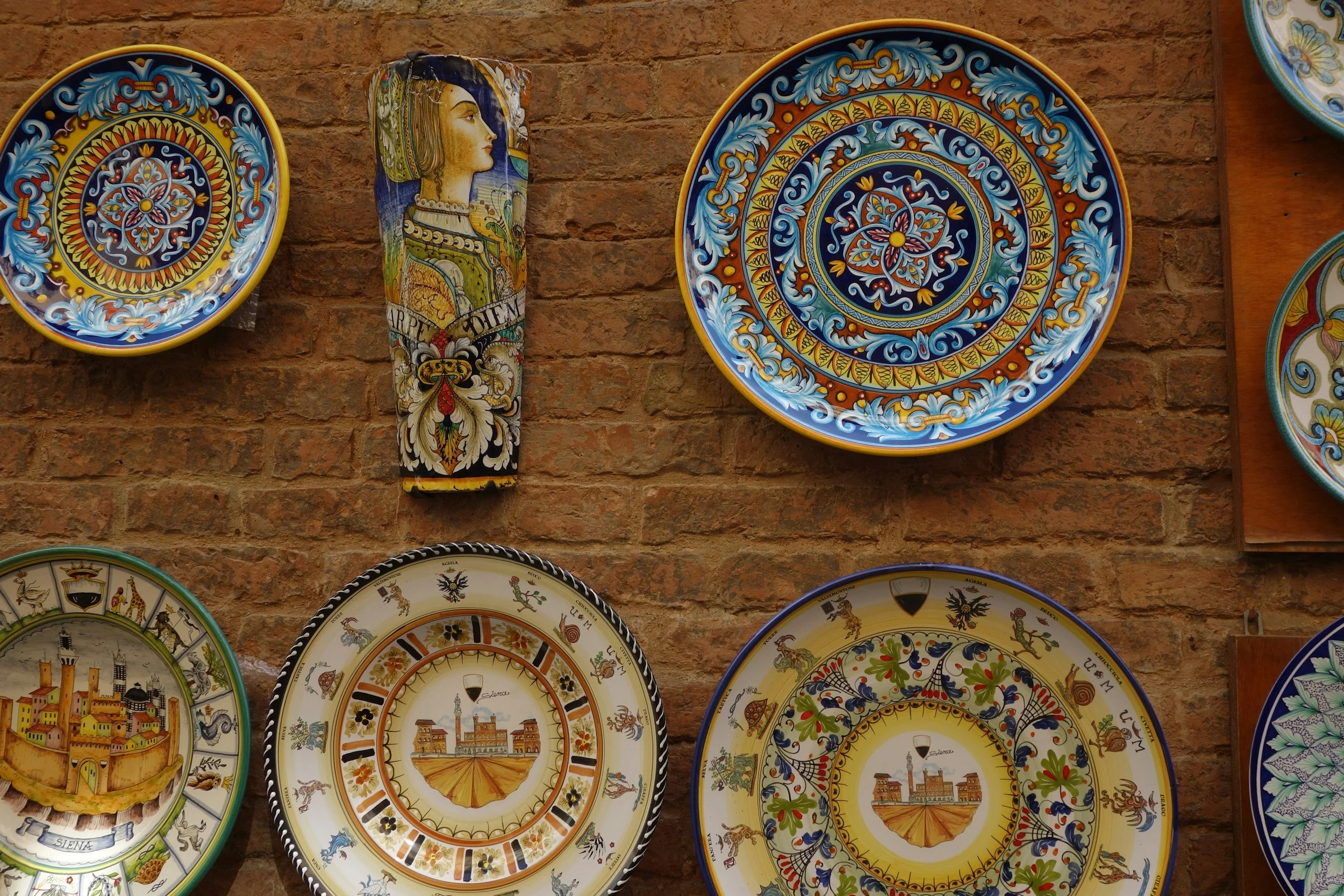
In 1509 the workshop of Lorenzo di Piero Sartori in Montelupo Fiorentino painted a 38-centimetre basin with putti, dolphins, cornucopias and crabs, on grounds of blue, orange and a deep, almost blood-like red. That basin, the Rosso di Montelupo, is now the signature piece of the town's Ceramics Museum. It sums up what this small town on the Arno was between the 15th and 17th centuries. This was Florence's pottery kiln, the place that sent out maiolica ceramics to the tables of Florentine families, to convent pharmacies and to ports across Europe. Which leaves one question. Did the Medici really commission Montelupo maiolica? The short answer is yes, with a few caveats.
Why Montelupo
Montelupo Fiorentino sits where the Pesa river flows into the Arno, at the start of the lower Arno valley. Potters were already at work here by the late 13th century, and the walls of the Florentine castle date from 1348. The turning point came in 1406, when Florence conquered Pisa and gained access to the sea. From then on the Arno carried Montelupo's wares down to the ports of Pisa and, later, Livorno.
The golden age ran from about 1480 to 1510. Around 1500 more than fifty kilns were working in town, and Montelupo became Florence's pottery kiln, much as Deruta was for Perugia.
In September 1490 the Florentine merchant Francesco Antinori signed a contract with twenty-three Montelupo potters that gave him their workshops' entire output for three years, for sale abroad. Prices depended on the grade, from ordinary maiolica to "damascene" wares inspired by Spain and the East, up to the "vantaggino", the new Renaissance polychrome. Fragments of Montelupo pottery have turned up in excavations in London, Southampton and Amsterdam, and at archaeological sites as far away as Central America and the Philippines.
Did the Medici commission Montelupo maiolica?
Yes. The Ceramics Museum names the Medici among the main patrons of Montelupo's workshops, and the Medici balls turn up often on plates, jugs and flasks. There's a caveat, though. The coat of arms of the ruling family was sometimes just a generic tribute, and on its own it doesn't prove a direct commission.
Some pieces leave no doubt. Flasks bearing the joined arms of Ferdinando I and Christina of Lorraine date from between 1589 and 1602. The Pozzo dei Lavatoi, the dig the museum grew out of, produced a plate with grotesque decoration and the Medici arms from around 1510–1515.
Alongside the Medici, the Strozzi, Pucci, Corsini and Pandolfini families ordered from Montelupo too. For marriages between leading families, whole services were commissioned, hundreds of pieces painted with the patrons' coats of arms. Institutions bought here as well: the pharmacies of the convents of Santa Maria Novella and San Marco, the hospitals of Santa Maria Nuova in Florence and Santa Chiara in Pisa, and the Santa Fina pharmacy in San Gimignano.
At the end of the 15th century two Montelupo potters, Piero and Stefano di Filippo, moved to the Medici castle of Cafaggiolo in the Mugello and set up a workshop there. Their descendants, the Fattorini family, kept working in the Montelupo tradition. A few decades later Grand Duke Francesco I went after something rarer still. Between 1575 and 1587, in the Casino di San Marco in Florence, his workshop made Europe's first successful imitation of Chinese blue-and-white porcelain. The 1588 inventory listed 310 pieces, and only sixty or seventy survive today.
The Medici also had a residence in Montelupo. From 1587 Ferdinando I turned the Ambrogiana, where the Pesa meets the Arno, into a villa. Cosimo III later hung it with paintings of plants and animals by Bartolomeo Bimbi and Andrea Scacciati. From 1886 until early 2017 the villa housed a criminal asylum, later a judicial psychiatric hospital. It isn't open on a regular basis. In 2025 Italy's Ministry of Culture sent the town council a draft agreement, with the Region, to restore the villa and return it to public use.
The Ceramics Museum
The Museo della Ceramica opened on 24 May 2008 in a former school building on Piazza Vittorio Veneto, and it displays more than a thousand pieces. Much of the collection comes from fifty years of urban excavations. Many pieces are kiln rejects: plates that went wrong in the firing, thrown away by the potters and dug up centuries later.
The key find dates to 1973. During works in the oldest part of town, the Pozzo dei Lavatoi came to light, an old well filled with maiolica fragments. That material became the basis for dating the workshops' production.
The Rosso di Montelupo took a different route. The 1509 basin belonged to the Parisian banker Gustave de Rothschild, who died in 1912, then passed to an antiques dealer, and was bought for the museum in the early 2000s. Look out as well for the 17th-century "arlecchini", display plates with caricatured figures on yellow grounds.
Cèramica 2026, the December festival
Montelupo has tied its identity to a ceramics festival for more than thirty years. In 2026 the festival, now called Cèramica, takes over three weekends in December: 5–8, 12–13 and 19–20 December. This year's theme, "Fabbrica Novecento", sets 20th-century industrial production next to work by contemporary Italian and international artists.
The programme includes the ceramics market, with separate sections for professionals and amateurs, and a historical exhibition on Florentine ceramics of the 1950s and 60s. There's also the Open Studio international prize, workshops at the Scuola di Ceramica, guided tours and activities for families.
Practical information
Distance from Villa Agnolaccio: about 50 km, 45 minutes by car.
Ceramics Museum: Piazza Vittorio Veneto 10/11. Tuesday to Sunday 9:00–19:00, Monday 14:00–19:00, last entry 18:00. Full ticket €6, reduced €4, also valid for the Archaeological Museum; free on the first Sunday of the month. Hours and prices can change, so check the .
Cèramica 2026: 5–8, 12–13 and 19–20 December, .
Villa dell'Ambrogiana: not regularly open; any special openings are announced by the .
Combine it with: Vinci and the places of Leonardo are close by, and San Miniato is in the same area. For a city day, there's the guide to a day trip to Florence from Pistoia.
Villa Agnolaccio: your base for the Arno valley pottery towns
Villa Agnolaccio is about 45 minutes by car from Montelupo Fiorentino, on the hills 3 km from the centre of Pistoia. Our villa dates from the early 1700s, just as Montelupo's kilns were leaving their best years behind. You can spend the morning at the museum, have lunch in town and stop in Vinci before heading back to the gardens and the olive grove. From here Florence and Lucca are about an hour away.